European removals from the UK: how the move is planned
Last reviewed:
This page explains the practical choices in a European removal: which load type, which crossing, and what decides when your goods arrive. It covers our four destinations, France, Italy, Spain and Portugal. For an overview of each country, start at the international removals hub.
Should you book a sole-use vehicle or a shared load?
The load type is the biggest decision in a European removal, because it sets both the cost and how much control you have over dates. A full family home usually justifies its own vehicle. A one-bedroom flat to Lisbon or a part-load to Lyon usually travels better as a shared load, and costs less as a result.
| Option | Fits best when | Trade-off |
|---|---|---|
| Sole-use vehicle | A full house, or a move where the date at the destination is fixed | The vehicle runs to your schedule; you pay for the whole load space |
| Shared load | A flat, a part-load, or a move with flexible dates | Your goods travel with other moves on the same route; delivery follows the route plan |
| Store, then deliver | The new home is not ready, or the sale and purchase dates do not line up | Goods are held in UK storage, then delivered as a sole-use or shared load |
How do your belongings cross the Channel?
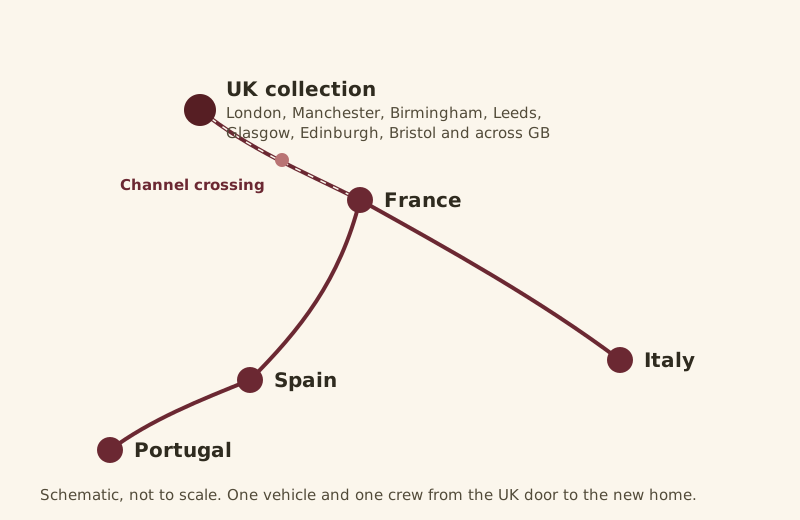
On the same vehicle that collected them. Most UK to France removals, and most moves continuing south to Spain, Italy and Portugal, cross on the Eurotunnel freight shuttle from Folkestone or the ferry from Dover. Both keep the vehicle and its contents together, so nothing is unloaded at a port. For moves to northern Spain and Portugal, a ferry from the south coast to the Spanish Biscay coast can cut out much of the drive through France. The written quote names the crossing planned for your move.
Collections start anywhere in Great Britain. London, Manchester, Birmingham, Leeds, Glasgow, Edinburgh and Bristol are the most common starting points. A move from Edinburgh to Spain simply has a longer UK leg than one from London to France.
What decides when your goods arrive?
We do not publish standard transit times, because the honest answer depends on the move. Your written quote gives an estimated window, and these are the factors that place delivery within it:
- Whether the load is sole-use or shared with other moves on the route
- Which crossing the route uses and how busy it is
- Customs processing at the destination, which depends on the paperwork being complete
- Access at the destination: narrow streets, upper floors, permits for parking a large vehicle
- Whether anything needs crating, such as artwork, pianos or antiques
Paperwork is the factor you control. A move with a signed inventory and proof of residence ready before collection clears customs on the first attempt. The moving abroad checklist puts those tasks in order.
How does EU customs apply to a UK household move?
All four destinations are EU member states, so the same customs framework applies to each. Household goods leaving the UK need an export declaration. At the border they need an import declaration in the destination country. Import VAT and duty are waived for a genuine change of residence under Council Regulation (EC) No 1186/2009. The relief applies when you have lived outside the EU for a minimum period and the goods are belongings you have owned and used, not new purchases.
Vehicles, alcohol, tobacco, firearms and items of high individual value carry their own rules. Tell the surveyor about them up front so they can be dealt with before the move rather than at the border. The customs and paperwork guide lists what we file and what you provide. The country guides cover the residence documents: France, Italy, Spain and Portugal.
European removals: common questions
What is the difference between a shared load and a sole-use move?
A sole-use vehicle carries only your goods and runs to your dates. A shared load puts your goods on a vehicle with other moves heading the same way, so the route plan sets the delivery slot. Your quote can price both.
Which Channel crossing do you use?
Usually the Eurotunnel freight shuttle from Folkestone or the Dover ferry, because they keep the vehicle and its contents together. For moves to northern Spain and Portugal a ferry to the Spanish Biscay coast is sometimes the better route. The quote says which crossing is planned.
Can you give an exact delivery date before we book?
Not before the survey. The written quote gives an estimated window based on the load type and route, and we confirm the delivery slot once the load is planned.