Why are moves to Italy planned around access?
Many Italian homes sit in places a removal vehicle was never meant to reach. The centro storico of a hill town in Tuscany or Umbria may be pedestrianised, or reachable only by lanes a car barely fits. A palazzo flat in Rome, Florence or Bologna may have a courtyard entrance and a stone staircase but no lift. A lakeside apartment near Como may front a road where stopping is restricted. None of this is unusual, and all of it is manageable, but only if it is known before the quote rather than discovered on the doorstep.
So the survey for an Italian move asks more about the destination than about the UK house: photographs of the street, the entrance and the stairs; whether a car can stop outside; and whether the address falls inside a restricted traffic zone. The answers decide whether the main vehicle can deliver directly or whether a smaller shuttle vehicle is needed for the final stretch.
Which Italian terms will you meet during the move?
A short glossary of the words that come up between survey and delivery, and what each one means for the removal itself.
| Term | What it is | Why it matters for your removal |
|---|---|---|
| ZTL (zona a traffico limitato) | A restricted traffic zone, common in historic centres and enforced by cameras | The removal vehicle needs a permit from the comune to enter. Without one, delivery cannot run as planned. |
| Occupazione di suolo pubblico | Permission to occupy public ground, such as a street or square | Often needed for the vehicle to park and unload in town centres. Applied for through the comune. |
| Comune | Your local municipality | Issues residence registration and the permits above. |
| Anagrafe | The comune’s population registry office | Where you register your residenza. The address should match the delivery address on the inventory. |
| Codice fiscale | Your Italian tax code, from the Agenzia delle Entrate or an Italian consulate | Needed for tenancies, utilities and most official dealings, including the customs side. |
| Permesso di soggiorno | The residence permit for non-EU nationals, which includes UK nationals | Evidence that your move is a genuine change of residence for customs relief. |
| Montamobili | An external furniture lift | Used where stairs or a small lift cannot take bulky items. Planned at survey. |
| Navetta | A smaller shuttle vehicle | Carries goods from the main vehicle into streets it cannot enter. |
Permit rules differ from one comune to the next. We check the rules for your address rather than assuming.
Which Italian documents do UK nationals need?
UK nationals are non-EU citizens in Italy. If you were resident before the end of the transition period, your rights are protected under the Withdrawal Agreement and evidenced by the residence document issued to Withdrawal Agreement beneficiaries. If you are moving now, you will normally need a national visa from the Italian consulate before travel, followed by a permesso di soggiorno applied for after you arrive.
Two other registrations run alongside. The codice fiscale identifies you for tax and contracts and can be obtained before you go. Residenza, registration at the anagrafe of your comune, records your address; the comune usually verifies it, often through a visit from the municipal police. For customs purposes, the certificate of residence, or evidence that registration is underway, is what links you to the address your goods are going to. The GOV.UK Living in Italy guide sets out the current requirements.
How are household goods cleared into Italy?
Goods arriving in Italy from the UK are an import into the EU. Transfer-of-residence relief under Council Regulation (EC) No 1186/2009 lets them in without import VAT or duty if you are genuinely moving your normal residence to Italy, have lived outside the EU for a minimum period beforehand, and have owned and used the goods for a period before the move. Italian customs (the Agenzia delle Dogane e dei Monopoli) asks for an itemised inventory and evidence of your new Italian residence alongside the declaration.
We prepare the inventory with you during packing and assemble the declaration for your signature. Vehicles, wine collections and items of significant value have their own rules, so mention them at survey. The general framework is on our customs and paperwork page.
How does the move run from survey to delivery?
The process is the same for every route we run. For Italy, the access permits sit between the written quote and loading, and they are part of our job rather than yours.
- Survey. Video or in-home, with as much detail about the Italian address as you can give, including photographs of the street and entrance.
- Written quote. One written quote, with any shuttle vehicle, external lift or permit built in and stated, not added later.
- Packing. Packed for a long road journey: ceramics, glass and framed pictures double-wrapped or crated. See packing services.
- Loading. Loaded so that anything transferring to a shuttle vehicle comes off in a sensible order.
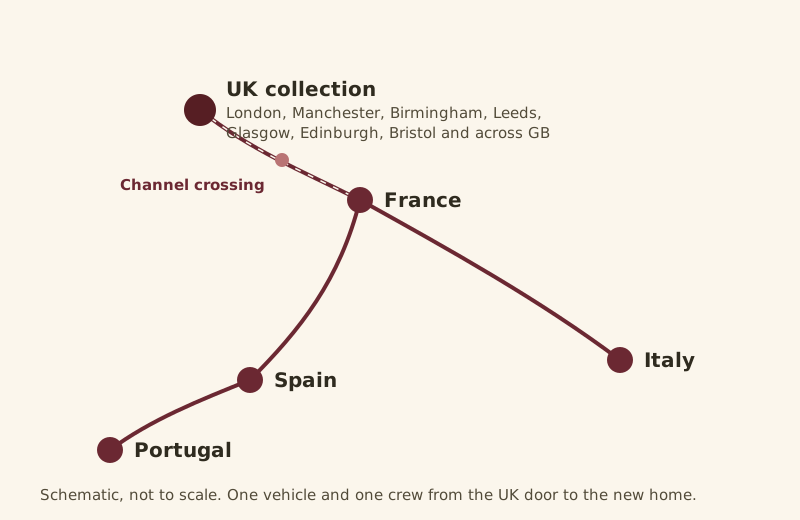
- Crossing. The vehicle crosses the Channel and drives through France, entering Italy through the Alpine tunnels or along the coast into Liguria, depending on where you are going.
- Customs paperwork. Export and import declarations, with the relief claim lodged against your residence evidence.
- Delivery. Unloaded, carried in, placed and reassembled. Where a ZTL permit applies, delivery runs inside its terms.
Where do our moves to Italy start and finish?
On the Italian side we deliver across the mainland, from Piedmont and Lombardy down to Puglia and Calabria; island deliveries add a ferry leg and are planned case by case. On the UK side we collect anywhere in Great Britain. Removals from London to Italy are the most common request, followed by moves from Manchester, Birmingham, Bristol, Leeds, Edinburgh and Glasgow. Wherever you start, moving from the UK to Italy with us means one crew and one vehicle from your front door to your new one.
Italian property purchases complete through a notary, and completion can slip. If it does, the load can wait in storage until the keys are yours. For other routes, see the France, Spain and Portugal guides, or the international removals overview.
Own vehicle or shared load to Italy?
For Italy, the deciding factor is often access: a sole-use vehicle can be timed to a ZTL permit or street-occupation permit, which is harder to fit around a shared route.
Both options can be priced on the written quote: a sole-use vehicle runs to your dates, a shared load travels with other moves on the route. In either case one crew loads and unloads, with no hand-off.
The European removals guide compares the options side by side, including storing first and delivering later. If your belongings will be stored before they leave the UK, mention it at the survey: transfer-of-residence relief only covers goods imported within a limited period after you move, so a long stay in storage can affect whether they qualify.
Where can you check the official rules?
For Italy, the GOV.UK guide covers the permesso di soggiorno, registering residence at the comune and the codice fiscale. Your comune can also tell you whether your address sits in a ZTL, which affects delivery.
This page summarises the rules rather than replacing them; check the sources below before you book.