What does a removal from the UK to Portugal involve?
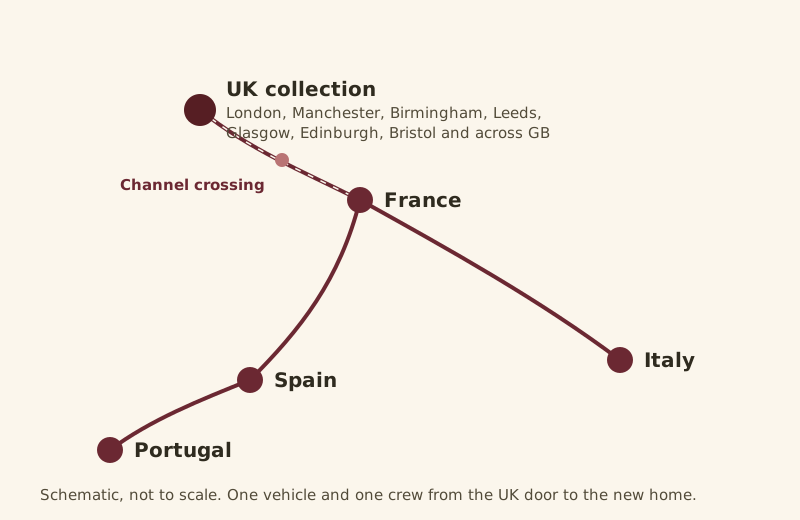
The vehicle that loads at your UK address crosses the Channel, drives the length of France and across Spain, and unloads at your door in Portugal. There is no transfer between vehicles and no third-party agent at the destination. Much of our Portugal work goes to Lisbon and the coast around it, to the Algarve and to Porto, with a growing share heading inland to the Alentejo and up the Silver Coast; all of it is quoted on the same basis.
The route is long but uncomplicated. What makes a Portugal move go well is mostly decided before the vehicle leaves: a load packed to survive the distance, and a paperwork file that reflects the current rules for UK nationals rather than the ones people remember from before 2021.
Why does the packing standard matter more on this route?
Distance does not change the paperwork, but it does change what a load goes through. On the Portugal route we work to a packing standard that assumes a long journey:
- Furniture is blanket-wrapped and strapped in place rather than simply stacked, so nothing shifts on the long motorway legs.
- Glass, ceramics, mirrors and framed artwork are double-wrapped or crated; anything irreplaceable is listed separately on the inventory.
- Mattresses and upholstery go into sealed covers to keep them clean and dry.
- Electronics travel in their original boxes where you still have them, or in purpose-made cartons where you do not.
- Every carton is numbered and listed as it is sealed, so the customs inventory and the unloading checklist are the same document.
If you would rather pack yourself, that is fine; we will advise on materials. See packing services for what professional packing covers.
Which assumptions about moving to Portugal are out of date?
Portugal has changed its residence and tax arrangements more than most destinations, and a lot of advice in circulation predates those changes. These are the ones we hear most often at survey.
| Assumption | Position for UK nationals now | What it means for your move |
|---|---|---|
| UK nationals register with a CRUE certificate | The certificado de registo (CRUE) is for EU citizens. UK nationals moving now normally obtain a residence visa from a Portuguese consulate, then a residence permit through AIMA. | Your residence evidence for customs is the visa and, later, the residence permit. |
| SEF handles residence permits | SEF has been replaced. Residence permits are now handled by AIMA, the Agency for Integration, Migration and Asylum. | Keep AIMA appointment letters and references with your move paperwork. |
| The NHR tax regime is open to new arrivals | The non-habitual resident regime closed to new applicants in 2024. A narrower successor regime applies to certain professions only. | It does not affect the removal itself, but take independent tax advice before planning around any tax status. |
| The NIF can wait until after the move | A NIF (tax number) is needed for leases, purchases, utilities and bank accounts, and is usually the first Portuguese number you obtain. | Get it early. Portuguese customs will ask for it with the change-of-residence paperwork. |
| Existing residents must start again | UK nationals resident before the end of the transition period are covered by the Withdrawal Agreement and hold a residence card that reflects it. | If that is you, your existing card is your residence evidence. |
This is a summary, not legal or tax advice. Confirm the current position with the official sources further down this page.
How is customs relief claimed for a move to Portugal?
Household goods entering Portugal from the UK are imported into the EU. Under Council Regulation (EC) No 1186/2009, transfer-of-residence relief removes import VAT and duty for people genuinely moving their normal residence to Portugal, who have lived outside the EU for a minimum period before the move and have owned and used the goods for a period beforehand. Portuguese customs (the Autoridade Tributária e Aduaneira) asks for the declaration together with your identity documents, your NIF, evidence of Portuguese residence and an itemised inventory.
Evidence of residence can include a certificate of residence from your local junta de freguesia (parish council) as well as your visa or residence permit. We prepare the inventory and the declaration with you; obtaining the residence documents is yours to do. Vehicles have separate rules. The framework is explained on our customs and paperwork page, and the GOV.UK Living in Portugal guide covers residence.
What are the stages of a Portugal move?
Seven stages, the same on every route we run. On this one, packing and loading carry more of the weight.
- Survey. We go through the load room by room and ask about the Portuguese address: town house, apartment or quinta, access, parking and any building rules.
- Written quote. One written quote, stating the packing standard, the route and what we have assumed about access.
- Packing. To the long-route standard above, with the inventory built as each carton is sealed.
- Loading. Load secured for a long road journey: heavy items low, fragile items boxed and braced, nothing loose.
- Crossing. The vehicle crosses the Channel and drives through France and Spain with the same crew aboard.
- Customs paperwork. UK export and Portuguese import, with the relief claim lodged against your NIF and residence evidence.
- Delivery. Unloaded, placed and reassembled, with every numbered carton checked off against the inventory with you.
Where in the UK do Portugal moves start?
Anywhere in Great Britain. We regularly run removals from London to Portugal, and collect just as readily in Bristol, Birmingham, Manchester, Leeds, Glasgow and Edinburgh. Moving from the UK to Portugal from the north of England or Scotland adds UK road before the Channel, but nothing else about the job changes.
If your Portuguese home is not ready when you leave, the load can wait in storage. For the other routes we run, see the France, Spain and Italy guides, or the European removals page for the shared EU framework.
Own vehicle or shared load to Portugal?
For Portugal, our longest route, a shared load often makes the most sense for a flat in Lisbon or Porto, while a full house in the Algarve usually justifies its own vehicle.
Both options can be priced on the written quote: a sole-use vehicle runs to your dates, a shared load travels with other moves on the route. In either case one crew loads and unloads, with no hand-off.
The European removals guide compares the options side by side, including storing first and delivering later. If your belongings will be stored before they leave the UK, mention it at the survey: transfer-of-residence relief only covers goods imported within a limited period after you move, so a long stay in storage can affect whether they qualify.
Where can you check the official rules?
For Portugal, the GOV.UK guide covers residence visas and AIMA residence permits for UK nationals, and the NIF tax number. Check it before relying on older articles, several of which still describe routes that have closed.
This page summarises the rules rather than replacing them; check the sources below before you book.