Which Spanish documents does the move depend on?
Listed roughly in the order most UK nationals meet them. Not every row applies to everyone; a buyer, a tenant and a returning resident each start from a different place.
| Document | Who issues it | Why the crew needs it |
|---|---|---|
| Passport | HM Passport Office | Your identity on the export and import declarations. |
| NIE (foreigner identity number) | Spanish police, or a Spanish consulate in the UK | The reference Spanish customs uses to identify you as the importer of the goods. |
| Spanish residence visa (new arrivals) | Spanish consulate in the UK | Establishes the basis of your move and is the step before a residence card. |
| TIE (foreigner identity card) | Spanish police, after arrival | The residence card for UK nationals, and the strongest evidence of a genuine change of residence. |
| Certificado de empadronamiento | Your town hall (ayuntamiento) | Confirms your registered address in the municipality the goods are going to. |
| Proof of your UK residence ending | HMRC, council or utility records | Supports that the goods are leaving a home you lived in. |
| Itemised, valued inventory | You, prepared with the crew at survey and packing | The list customs relies on. Every carton is matched to a line on it. |
If you lived in Spain before the end of the transition period, you will usually already hold a TIE that records your Withdrawal Agreement status. The green EU registration certificate is for EU citizens and is not the route for UK nationals.
What is the difference between an NIE and a TIE?
The NIE is a number. It identifies you to Spanish tax, banking, property and customs systems, and you need it for almost everything: buying or renting property, connecting utilities, opening an account and, for our purposes, importing your household goods. Many people obtain it through a Spanish consulate in the UK while buying a home, well before the removal is booked.
The TIE is a card. For UK nationals it is the document that proves residence in Spain, and it carries your NIE on its face. New arrivals typically apply for it at a police office in Spain after entering on a residence visa; residents covered by the Withdrawal Agreement hold a TIE that says so. For the removal, the TIE, or proof that you have applied for it, is the clearest evidence that this is a genuine change of residence rather than goods for a holiday home.
Why does the padrón matter to a removal?
Empadronamiento is registration on the municipal register at your local ayuntamiento. It is separate from your residence card, and it is the document that ties you to one specific Spanish address. Spanish customs and many other offices ask for the certificate, as do the processes for registering with healthcare and schools.
It helps us too, because the address on the padrón certificate should match the delivery address on the inventory. Get it as early as your tenancy or purchase allows. A mismatch between the address on your paperwork and the address the vehicle is heading for is one of the few things that can hold up an otherwise straightforward import.
How is customs relief claimed for a move to Spain?
Household goods entering Spain from the UK are an import into the EU and would ordinarily attract import VAT. Transfer-of-residence relief under Council Regulation (EC) No 1186/2009 lifts that for people moving their normal residence into Spain, provided they have lived outside the EU for a minimum period beforehand, have owned and used the goods for a period before the move, and intend to use them the same way at their Spanish home. Spanish customs asks for an application for the exemption supported by your identity documents, evidence of your new residence and the inventory.
We prepare that paperwork with you and lodge it with the load. What we cannot do is obtain your NIE, TIE or padrón for you, so the earlier those are in hand the smoother the import. Vehicles, alcohol and tobacco have separate rules. Our customs and paperwork page explains the framework in more depth, and the GOV.UK Living in Spain guide is the place to confirm the residence side.
What happens between survey and delivery?
The sequence is the same as on any of our routes. What differs for Spain is where the paperwork falls and which way the vehicle goes.
- Survey. We look at the load and ask about the Spanish property: apartment or villa, lift or stairs, community rules, parking.
- Written quote. One written quote for the whole job, stating what is included and what we have assumed about access at both ends.
- Packing. Professional packing if you want it (see packing services), with cartons listed on the customs inventory as they are sealed.
- Loading. Loaded by the same crew who will unload in Spain, in the order the Spanish end needs.
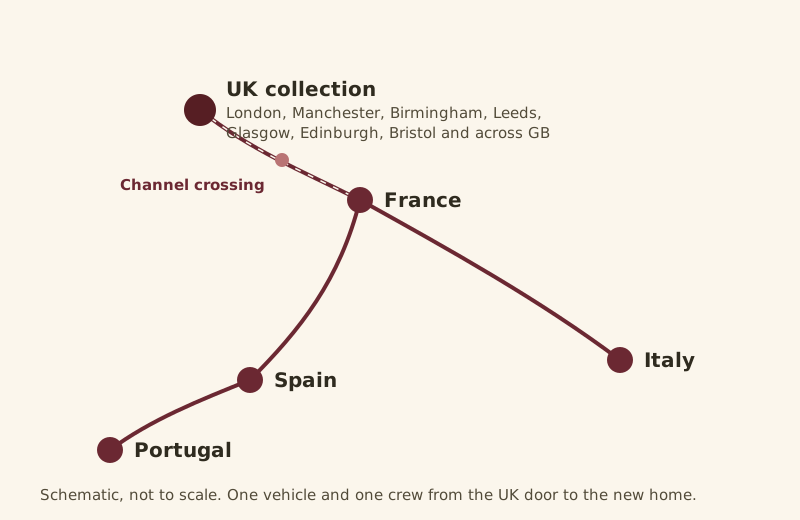
- Crossing. The vehicle crosses the Channel and drives south through France, or takes a direct ferry to northern Spain where that suits the load and the destination.
- Customs paperwork. Export from the UK and import into Spain, with the relief claim lodged against your NIE, residence evidence and padrón.
- Delivery. Unloaded, carried in, placed and reassembled. Packaging taken away on request.
What should you know about delivering to Spanish apartments and urbanizaciones?
A large share of UK to Spain removals end at an apartment or a gated development. Each of these points has changed the plan for a delivery at some stage:
- Community of owners rules. Many blocks and urbanizaciones are run by a comunidad de propietarios that decides when removals may take place and whether the lift can be used. Ask the administrator before you book, and pass on what they say.
- Lift sizes. Lifts in older blocks on the Costa del Sol and in central Madrid and Barcelona can be small. Sofas and wardrobes may need an external furniture lift, which we plan at survey.
- Street permission. In city centres the town hall may require permission for a removal vehicle to occupy the street. We will tell you if your address needs it.
- Hillside villas. Properties in the hills behind Alicante, Málaga and Valencia often have steep, narrow access roads. A smaller shuttle vehicle for the last stretch is planned in, not improvised.
- Completion gaps. If your Spanish purchase completes after your UK sale, the load can wait in storage.
Which UK cities do Spain moves start from?
We collect across Great Britain. Removals from London to Spain make up a large share of the work, but moves from Birmingham, Manchester, Leeds, Bristol, Glasgow and Edinburgh to Spain are routine and are quoted in exactly the same way. Moving from the UK to Spain from the north simply adds UK road before the Channel; everything after it is the same crew, the same vehicle and the same paperwork.
Comparing destinations? The France, Italy and Portugal guides take a different angle on each route, and the European removals page sets out the EU framework they share.
Own vehicle or shared load to Spain?
For Spain, shared loads are common on the busy routes to the Costa Blanca and Costa del Sol; a sole-use vehicle suits moves timed around a completion date or a community-of-owners delivery slot.
Both options can be priced on the written quote: a sole-use vehicle runs to your dates, a shared load travels with other moves on the route. In either case one crew loads and unloads, with no hand-off.
The European removals guide compares the options side by side, including storing first and delivering later. If your belongings will be stored before they leave the UK, mention it at the survey: transfer-of-residence relief only covers goods imported within a limited period after you move, so a long stay in storage can affect whether they qualify.
Where can you check the official rules?
For Spain, the GOV.UK guide explains the NIE, the TIE residence card and registering on the padrón, and links to the Spanish consulate's visa pages. Rules for UK nationals who were resident before Brexit differ from those for new arrivals.
This page summarises the rules rather than replacing them; check the sources below before you book.